

by Jim Beaugez
Putting the Mississippi State Penitentiary at Parchman in the rearview mirror is a relief for many who have crossed beneath the lettered awning at its entrance off Highway 49 West in Sunflower County.
But for musician Jimbo Mathus, who visited the infamous prison one autumn day this past October, it was a more complicated experience.
With miles of flat Delta farmland behind him, the chaingang recordings made by John and Alan Lomax at the men’s prison in 1933 playing on the stereo, and the experiences he’d just had on his mind, Mathus had to pull his van off the road.
“I just lost it,” he says over the phone from Nashville, where he’s spending a day off from touring with The Black Keys. “To see the spirit of positivity emanating out of there, and the redemption, it tears me up, absolutely devastates me,” Mathus says. “And it gives me a lot of hope.”
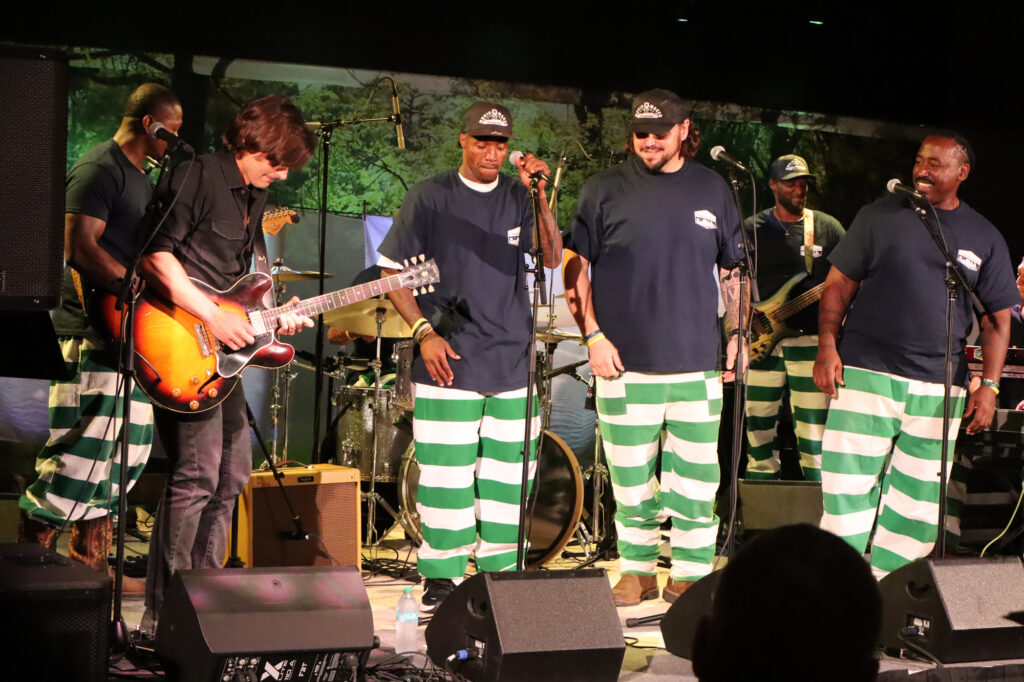
Just five years and change removed from a prison riot at Parchman that stretched three weeks and claimed five lives, Mathus met some of the men writing the next chapter in Parchman’s 125-year story. Under the leadership of superintendent Marc McClure, cultural programs are once again available to imprisoned men—and the revival of the Parchman Band, dormant for three decades, is spreading that hope around.
“Originally, I just wanted to start it back,” McClure says, “because it fit a broader vision of bringing more rehabilitation, more programs, more outlets for people.”
McClure came across records made by previous iterations of the group in the prison’s museum and saw how it could help fulfill his mandate to transform Parchman into a rehabilitative center. McClure enlisted 35-year-old inmate Houston Jones, who has played piano since childhood, to hold auditions and begin piecing together the now seven-piece band.
“It was an emotional process to start the band back up and learn the history and realize we were bearing a torch,” says Jones.
Along with inmates like bassist and vocalist LJ Stevenson, who played professionally before he was sentenced to Parchman, Houston committed to rehearsal on Tuesdays and Thursdays beginning in September 2023, scheduled around the members’ jobs and studies (Stevenson was studying theology at the time). By October, the group was performing weekly for fellow inmates.
Parchman’s musical shadow stretches back to its beginnings as a penal farm notorious for its harsh conditions. Blues musicians like Bukka White were among the inmates at various points—his recording of “Shake ‘Em on Down,” tracked before he was sentenced for a shooting incident, became a minor hit while he was imprisoned—and John Lomax recorded him at Parchman for the Library of Congress in 1939. After his release, he recorded “Parchman Farm Blues” about his experiences. Son House and others also served time there.
Parchman had an organized band as early as the 1930s, and in 1952 a more modern group emerged and evolved. Under the direction of band leader Wendell Cannon, the band recorded for Malaco Records in Jackson and performed around the state into the 1990s, when administrative changes and tightened security caused the members to disband.
“Some of these people have been locked up a long time, and they were like, ‘I haven’t heard a live band in 30 years,’” says McClure. “That was really positive for them and for the whole prison to have an outlet now where you not only have musicians getting to enjoy what they do, but then people are receiving positive things from the band.”
While playing for the prison’s nursing home unit, a man approached Jones at the end of the set and asked them to play “Happy Birthday” for one of his friends. They hadn’t played the song before but quickly worked up a “rocking, jazzy” rendition and played it for him.
“And the guy just sobbed,” Jones says. “He was in tears, and he hugged us and hugged us. And two weeks later, he died. We were the last music he ever heard. That was the defining moment of our mission at that point. It gave me a mission.”
In May, the Parchman Band backed Charlie Worsham, the Grenada-kid-made-good who is now one of Nashville’s most respected guitarists and songwriters, on a four-date tour through Mississippi. The group practiced seven days a week in the fortnight leading to their first show with Worsham, held at the MAX in Meridian. After an opening acoustic set from Worsham and a set of Parchman Band originals that showcased their melting-pot sound of soul, blues and rock and roll, they backed Worsham on tunes like Merle Haggard’s “Branded Man,” written about the stigma he experienced following his release from prison. The crew brought the show to Philadelphia’s Ellis Theater and the Grammy Museum in Cleveland, then wrapped the tour with a gig at Parchman’s Family Day.
“The band is a way for people to see that they are human beings, and that there’s things we need to look at differently,” McClure says. He’s heard inmates express finding purpose through being part of the band. “They say, ‘If this is where I’ve gotta be, I would rather be doing something meaningful instead of just feeling helpless or useless.’”
As word of the band spreads, they’re also gearing up to reach a broader audience. Late in 2025, Tim Duffy with the Music Maker Foundation saw a post Mathus made about the band on social media and reached out about possibly releasing their original songs. And in March, Mathus produced their recording session at Dial Back Sound in Water Valley. Music Maker plans to release the album and a documentary on the band in February 2027.
Now that the Parchman Band has a dedicated practice room, they rehearse four to six days a week. They not only perform at Parchman, but also at correctional facilities around the state—and in their wake, new musical groups are forming. After the band performed at Marshall County Correctional Facility in April 2024, the inmates formed a blues band of their own. Central Mississippi Correctional Facility in Rankin County has a group, too. And Jones says they just helped inmates at the Delta Correctional Facility, which houses in the neighborhood of 300 women, order equipment so they could start a band.
“Even though the other inmates can’t go out, they know that somebody is out there representing them and showing that everybody in prison is a human being,” McClure says. “It’s meaningful to all of them.”
McClure says he expects the bands to continue growing—and hopefully, continue to raise morale among the imprisoned men and women and give them hope and purpose that will serve them both inside and outside of the prison walls.
“What is special is the opportunity to make a difference in somebody’s life,” Jones says. “We have had people come up to us and say, for the two hours you played, I felt like I was free. We are taking prisoners out of prison for an hour and a half or two hours when we’re playing, and to us, that is special.”