

Melissa Ridgway’s home-based business began with a dozen vintage decoys and grew into a celebrated collection of American folk art, hunting antiques, and one-of-a-kind finds
by Sherry Lucas • photography by Tom Beck
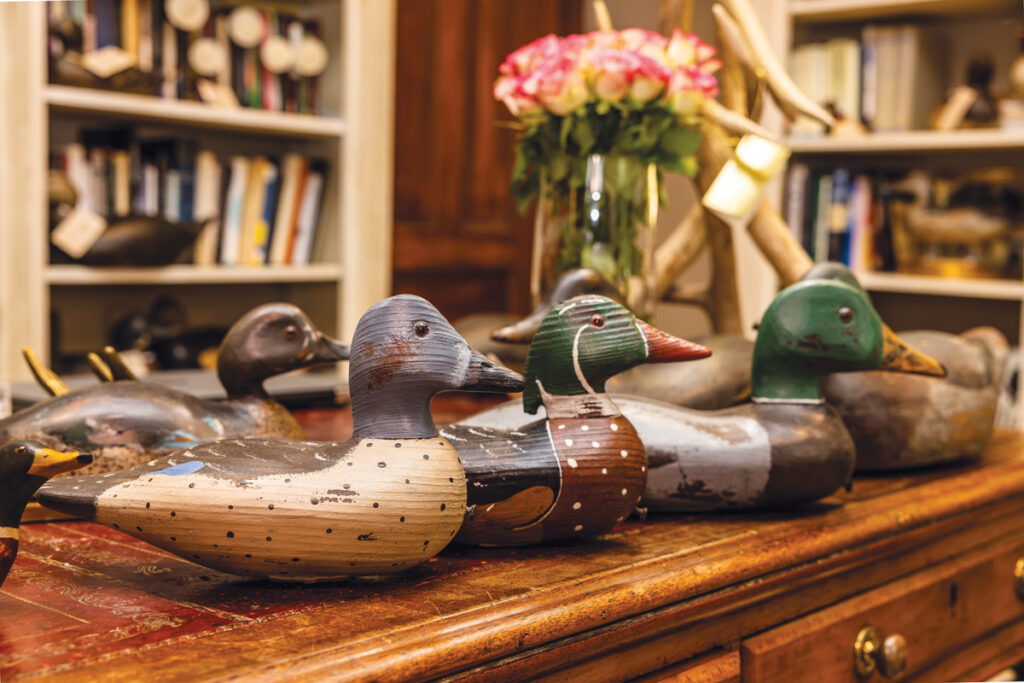
When a flea market barrel of decoys caught Melissa Ridgway’s eye, little did she know how huge flocks of waterfowl would flap their way through her life and livelihood in the ensuing decades, hatch a small business and christen her with a new identity.
She became “The Duck Lady.”
Ridgway’s Unlimited Ducks home-based business in vintage and new duck decoys, fish and game-related art, antiques, and accessories never needed an actual advertisement to take flight. Word of mouth and relationships did all that, building a network of contacts and clients who keep a steady stream of decoys and more coming in her front door and flying back out.
Sales skills honed as a teen in her dad’s Western Auto store, her knack for decor and her ability to snap up something she adores and then turn it loose at a profit all come together in Unlimited Ducks.
She and husband, Richard, were on a 1984 road trip to the East Coast when they came across the hand-carved ducks that decided her fate. “He had always wanted some old decoys,” she says.
Hunt turned to harvest when they found a dealer, “Miss Nancy,” as Ridgway recalled, at a Greensboro, S.C., flea market. The dozen decoys that rode home with them, lined up in the back window of his mom’s Oldsmobile Delta 88, soon found perch along the length of her dining table.
Add some magnolia boughs and apples—that would be cool for Christmas, Ridgway thought and happened to mention, too, to all her girlfriends. Now, they wanted decoys.
“Go ahead and sell them,” Richard told her, and with a slight markup the ducks were gone within a week. She rang up Miss Nancy for more and a business was born.
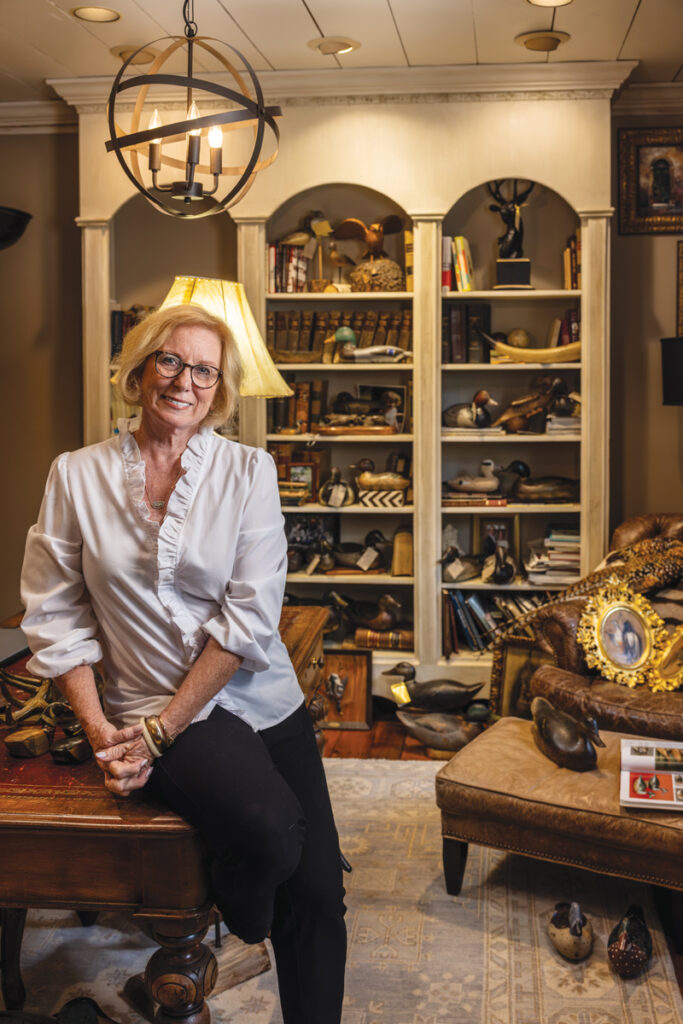
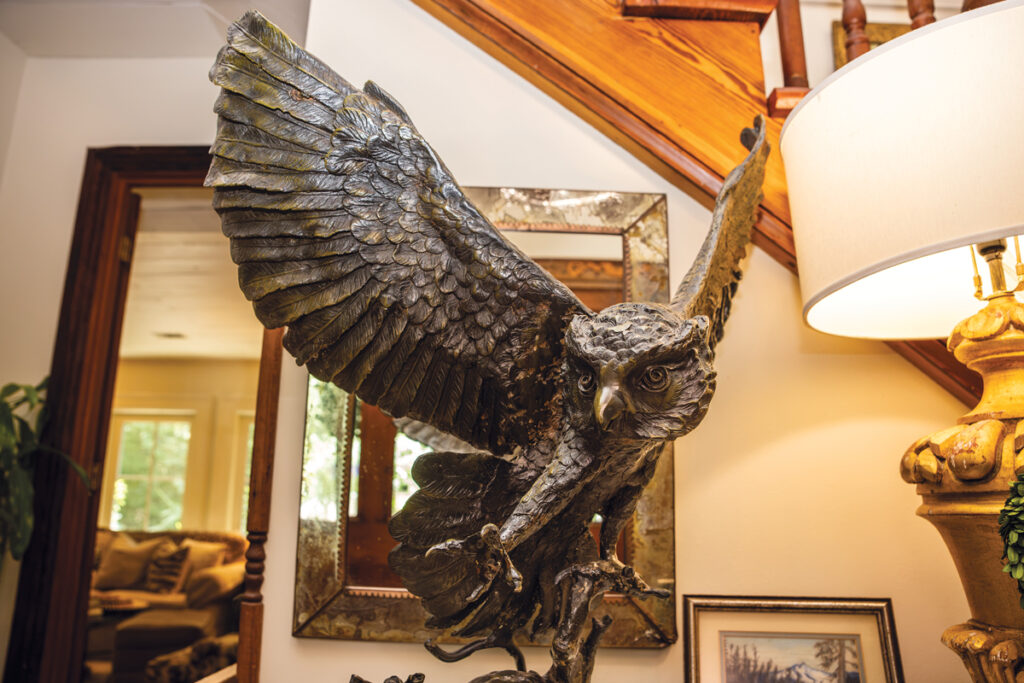
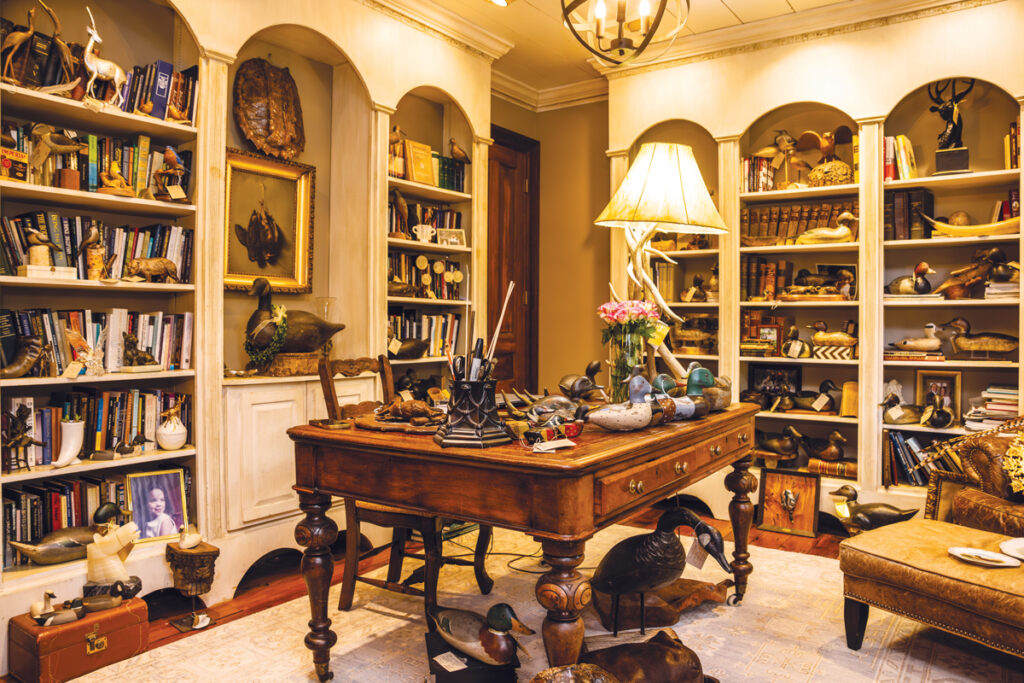
It was the perfect way for Ridgway, then a psychometrist testing exceptional children, to be able to stay home with her own four kids. She turned her husband’s study into a by-appointment “studio,” honing in on decoys but expanding her scope to related art and antiques such as bird carvings, roe skull mounts, European hunting trophy paintings, and vintage creels.
Richard gets credit for igniting her interest. “I didn’t initially appreciate these things, and I couldn’t see the beauty in them until he just had a fit” over them, she says. The deeper she studied the decoys, the more artistry she saw. “The mark of the Creator is definitely on the waterfowl,” she says, and carvers artfully mirrored that beauty.
Ridgway started as Tin Roof Antiques, but settled on Unlimited Ducks to signal her mainstay merchandise when she joined vendors at Mistletoe Marketplace 41 years ago. Though she has pulled back from a schedule that once included Junior League shows across the South, her website (unlimitedducks.com), Instagram (unlimited.ducks), and a trove of longtime clients keep things humming. Ridgway can also be reached directly at melridgway@gmail.com.
She learned the decoy trade from much older men across the United States who had been in the industry for years. “They all would kind of raise their eyebrows when they first saw me, because I was younger and I was a woman and I had to make my place with them.” As she started to learn, she’d casually throw out observations like, “Oh, this is a Gundelfinger from Missouri.”
“They’d ask, ‘How do you know that?’” She knew because she’d studied the decoys. “You have to have some humility, some forgiveness, some well-honed relational skills, and some savvy discernment to be able to fit in with this wonderful group of dealers, which is a very small group across country who buy and sell these old decoys. I’ve so enjoyed that.”
She relishes, too, the way form, function, beauty, and story ripple through these decoys, especially in the famous Mason decoys from Detroit, made in the late 1800s and early 1900s and a specialty for her. “Think about that guy,” she pointed to a lovely wood duck. “He was floating in the water 100 years ago … and how somebody was so careful to make something so utilitarian like that, splendid.”
Even more affordable options, such as less finished decoys from Pascagoula factories from the 1930s and ’40s, hold true folk art appeal.
Ridgway’s skills of persuasion are as sharp as her eye. Three little ducks, not decoys but sure charmers, have bodies fashioned from antique golf clubheads. She’d bought a pair and immediately tried tracking down the artist. “When I finally got him, I said, ‘You don’t know me, but I want some of these to sell.’”
Brick wall. He didn’t do that anymore. His wife died a couple of years ago. He was in his 80s. It was hard to get the golf clubs. Too cold in his shop. “You don’t know me, but you’re going to do some for me,” she countered.
“It makes me so sad,” he pushed back. So did she. “Do you have some golf clubs? You don’t know me, but you’re going to do me 10 if you’ve got ’em.”
He sent them and a few weeks later called, “I’m back, and I feel her with me so I won’t put it down.” That touched her, forging another friendship. His claim to fame is that Clint Eastwood collects those for friends, Ridgway says, and shared a few of her own celeb customer connections—Amy Grant and Meredith Brokaw (Tom’s wife), both at Mistletoe.
“Those parts of it are just real fun,” she says, but the everyday people who fall in love with the one-of-a-kind pieces are at the heart of her business.
Gifts are a big driver, and many clients build collections for loved ones one birthday and Christmas at a time. How can she part with such fine pieces, like an antique hunting still life so perfect over her own mantel it could have been commissioned for the spot? Ridgway shrugged, confident in a practice that has sent not only decoys and art, but also her sideboards, kitchen chairs, and Oriental rugs to new homes.
“I told my children, ‘Be careful, or I’ll sell you right out of this house!’” she teased.
She does not get attached to the things. “The relationships that we have made through these forty-one years of doing this is the treasure,” Ridgway says, from sharing a glass of wine as clients peruse her stock to chasing down a particular piece for the perfect gift. “I am building something with them that goes beyond this art. And, I’ll remain friends with them, and then they come back and they bring a friend and that’s how my clientele is built.” Many have been collecting with her over a 35-year span.
“There is a richness to passing on the love for these early American art forms to others, and to see them fall absolutely in love with them, even more than I am.” Special, too, is seeing them passed along to the next generation. “It’s so very rewarding.”
Her son, Grant, came on board about a decade ago, helping with markets, accounting, and website duties for the business, plus annual trips to the Chicago show where she does a part of her buying. Though it was hard to give up, last year marked Ridgway’s final one at Mistletoe Marketplace, as she focuses more on decorating hunting lodges across the region, in-home showings, and her website.
Her inventory ranges from $50 accessories to $12,000 decoys and art, with typical decoy sales between $200 and $2,500 each. Vintage decoys are highly collectible American folk art and their value keeps climbing. “The days of finding them in attics or Grandaddy’s barn are kind of over,” she noted. The market reached a new pinnacle in the 2000 Sotheby’s auction of Dr. James M. McCleery’s carved birds and vintage decoys collection, which fetched a total sale of nearly $11 million (about doubling pre-sale estimates).
“There’s a history in the last twenty or so years of these things making the front page of The Wall Street Journal because they sell for $1 million.” She was at the April auction when two hit that record price and even held one of them, a superbly painted Joseph Lincoln wood duck.
But the ones with wear, like the 1898 Mason Premier blue-winged teal in her studio? Those are her faves. “If it could just talk and tell us the stories of what swamp it had been in, and how long it stayed there, and did it get thrown in the boat or the back of the truck? Or was it in a horse and buggy? And, did they hunt with it in their coats and ties like they did up in the Northeast?
“Each one has a story.”