
By JIM BEAUGEZ
Will Griffith plows the fertile ground of a life on the road in The Great Dying

Roughly 252 million years ago, the world as it existed for prehistoric fauna abruptly ended.
Known as the Permian-Triassic extinction event and nicknamed the “great dying,” this cataclysmic reboot wiped out ninety percent of marine life and seventy percent of land animals. In addition to resetting the balance of life on Earth, it also laid the groundwork for the diversity of life today. It’s a heavy name for a band, but for Oxford musician Will Griffith, it fits.
“I like the way it sounds,” says Griffith, who’s spent a lifetime wandering back roads collecting stories from the Delta to the San Juan Mountains of Colorado. “It sounds morose and morbid, but actually, without it, we wouldn’t be here, you know? Everything moves forward all the time, and new things are born.”
That tension between death and rebirth, as well as desolation and beauty, runs like a backbone through the music Griffith makes as The Great Dying. Imbued in the traditions of Americana music—a catch-all for the Venn diagram where country, blues, and rock and roll overlap—and informed by the storytelling of singer-songwriters like John Prine and Jason Isbell, Griffith is part of a new vanguard of old souls singing truths as ancient as time.
Griffith’s Delta roots began in Boyle, Mississippi, but they spread wide across a cultural cross-section of music, family, and southern grit. His mother’s side worked the land as farmers who also dealt in dirt and gravel, while his father, Nicky Griffith, was a member of Joe Frank and the Knights, a beloved rock band in the 1950s and 1960s.
Music was never scarce in the Griffith household. His mother, Anita, painted and loved R&B artists like Aretha Franklin, Tina Turner, and the muscular soul of Stax Records, while his father spun records by Pink Floyd, Led Zeppelin, and The Animals. His grandmother, meanwhile, introduced him to Hank Williams and the Righteous Brothers but also entertained the young musical omnivore’s tastes by buying him the Metallica and Ozzy Osbourne cassettes he wanted.
Griffith spent a lot of time in the wide-open spaces of the Delta, absorbing that seemingly contradictory mix of tender country ballads beside explosive punk and bombastic metal.
“I was alone a lot,” he says, “pretty much left to my imagination for most of my childhood.” Music filled in the blanks, but so did skateboarding, which became a compass pointing beyond Mississippi’s borders. He learned about skateboarding and punk rock from underground magazines and kids in nearby Cleveland and identified with the outsider perspective those interests engender. “Skateboarding magazines meant everything,” he says. “That was my source for everything outside of what I knew, from music to the clothes I was wearing. I lived for skateboarding for 20-something years.”
But as his interests evolved in his late teens, his musical tastes turned toward the strain of country rock that spoke in hard truths and minor chords loosely tagged as “no depression,” taken from the name of Uncle Tupelo’s 1990 debut album (itself a nod to the Carter Family song of the same name), or alt-country. Song-oriented artists like Whiskeytown, Lucinda Williams, and The Jayhawks lit a fire under his creativity.
“My friends Hank Panton and Bo Powell were always ahead of everybody—they just always knew what was good,” he says. “I quit listening to everything else and got into the singer-songwriter stuff. That’s when I started playing the guitar all the time and started singing more, coming up with melodies.”
Griffith cut his teeth playing house parties and halls around Cleveland, Mississippi, first in a punk band, then as a bassist in a jam band with older players. “I was the youngest by about ten years,” he recalls. By 21, he was standing front and center, acoustic guitar in hand, sharing stages with other singer-songwriters in smoky bars across the Delta.
He formed his first real band, Disposable Faces, and continued building a catalog of his own songs. The band played bars around the region and earned a following in Mississippi college towns like Starkville and Oxford. “We did really, really well,” he says. “But I wanted more.”
Griffith hit the road on his own, spending time working in restaurants in Colorado. (These days, he works behind the bar at Proud Larry’s when he’s not on the road.) At age thirty, he landed in Nashville and eventually made his way to Oxford, where his creative life finally blossomed.

“I’ve always liked Oxford,” he says. “It’s close to the Delta, and it’s central to everywhere I can tour. I can get to so many places in the Southeast.” More importantly, it welcomed him into a thriving creative community. He found kindred spirits in musicians like Kell Kellum and Matt Patton of Drive-By Truckers, who also owns the Dial Back Sound recording studio in Water Valley, and appeared in the video clip for “City Watched Me Burn,” a 2021 tune by his friend and Oxford songwriter Anne Freeman.
After recording his debut album as The Great Dying, the 2018 long-player Bloody Noses & Roses, Griffith began touring outside Mississippi with assists from Craig Pratt, Kellum, musician-writers Max Hipp and Tyler Keith, and other Oxford-area musicians. His affiliation with the Truckers helped him gain fans around the country and set up his latest release, 2024’s A Constant Goodbye, which features appearances by Patton and his bandmate Jay Gonzalez.
Griffith’s songs pull from the fields and gravel roads of his teenage years, where he spent afternoons driving with no destination other than absorbing the music that jumped from his speakers.
“I grew up riding in the country, either by myself or with friends,” he says. “And that’s all we did—ride gravel roads all day long.”
For all its natural beauty and cultural weight, the Delta inspired him but couldn’t hold him forever. Griffith came of age during a time when old-guard blues masters like Willie Foster and “Cadillac” John Nolden still roamed the region’s juke joints. He worked at the Airport Grocery in Cleveland, brushing shoulders with the last generation of Delta legends. He played Po’ Monkey’s, the storied club near Merigold, more than once and acted in a film shot there by Ben Powell, who has also directed a couple of his music videos.
You can hear all that history in his voice, a clarion-clear drawl with phrasing and melodies at times reminiscent of R.E.M.’s Michael Stipe. There’s a throughline of heartbreak and hardscrabble truth, but also something elemental, like he’s channeling the sediment beneath the surface.
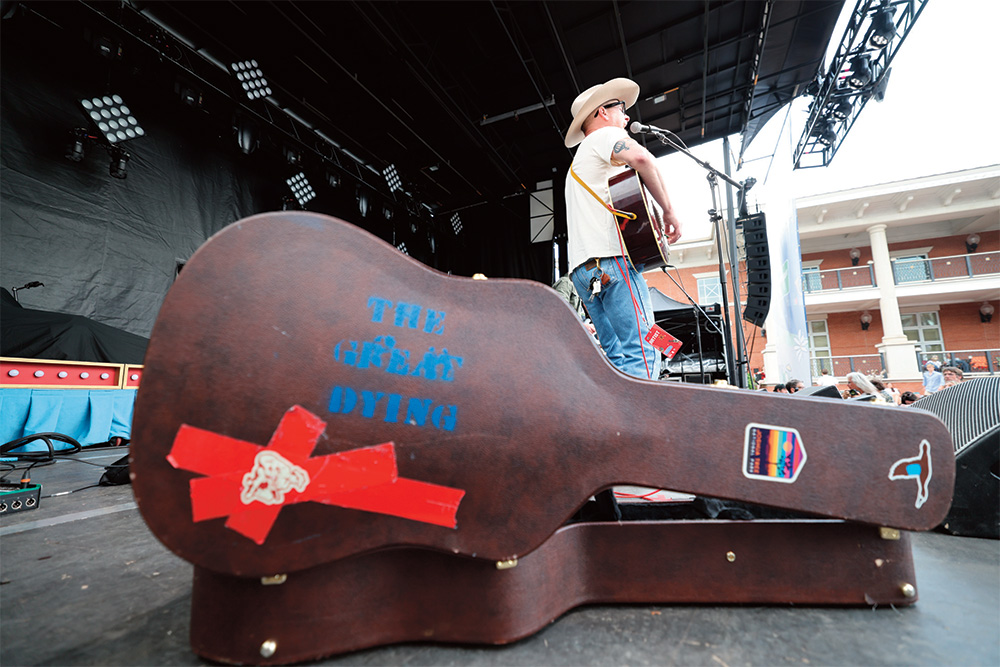
To date, Griffith has logged more than 300 shows across forty states and Canada—sometimes solo, sometimes with his friends as sidemen. He’s gearing up for another summer run that’ll take him through Nashville, Chicago, and many towns between.
But he’s not chasing anything flashy. What drives Griffith isn’t fame or fortune—it’s the same pull that led him down gravel roads as a teenager with nothing but a stereo and a tank of gas. It’s about movement, survival, connection, and moving forward so new things can be born. And without a doubt, the Delta is still the foundation of his music.
“I write so much about it,” he says. “All the landscapes, the river, the openness, and the solitude.
There’s a lot of freedom in the Delta.”